


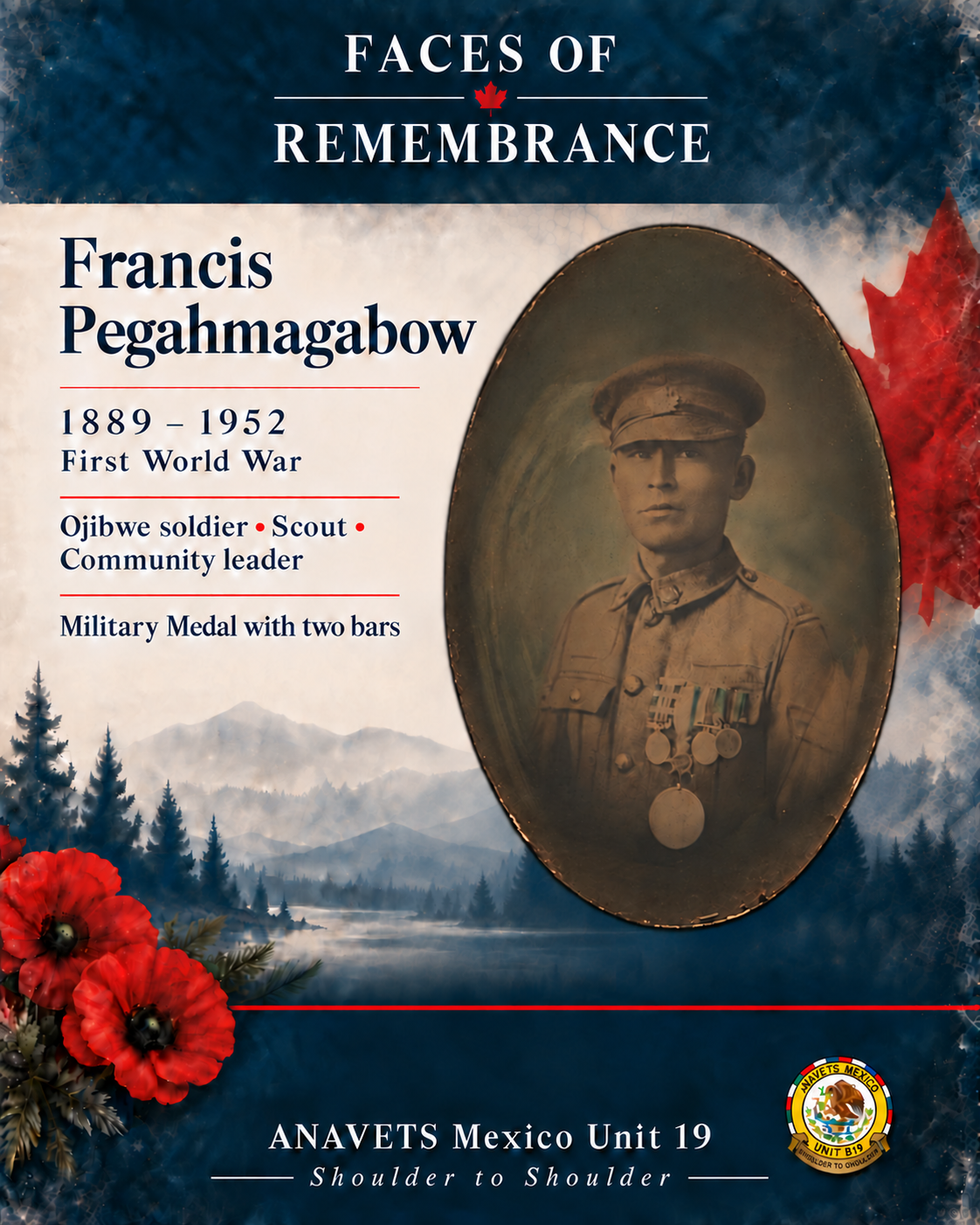
As Remembrance Day approaches, ANAVETS Mexico Unit 19 is sharing the stories of Canadians whose service, courage and sacrifice should not be forgotten.
We begin with Corporal Francis Pegahmagabow, MM, one of the most highly decorated Indigenous soldiers of the First World War.
From Georgian Bay to the Western Front
Francis Pegahmagabow was born on March 9, 1889, near Georgian Bay, Ontario. An Ojibwe Nishnaabe and a member of what is now Wasauksing First Nation, he was among the first Canadians to enlist after the First World War began in August 1914.
He joined the 1st Canadian Infantry Battalion and travelled overseas with the first contingent of the Canadian Expeditionary Force. By February 1915, he was serving in France.
Pegahmagabow became known as an exceptional scout and marksman. His patience, fieldcraft and ability to move through dangerous territory made him especially valuable on the Western Front. He also carried messages under fire—work that demanded courage, sound judgment and an extraordinary disregard for personal danger.
Courage under fire
Pegahmagabow served in some of the most difficult battles of the war, including the Second Battle of Ypres, the Somme and Passchendaele. He was wounded in the leg during the fighting on the Somme but recovered and returned to his battalion.
For his bravery and devotion to duty, he received the Military Medal and two bars, representing three awards of the same decoration.
His first Military Medal recognized his continuous service as a messenger from February 1915 to February 1916. During the fighting at Ypres, Festubert and Givenchy, he repeatedly carried messages successfully through dangerous conditions.
At Passchendaele in November 1917, he maintained contact with units on the flanks before and after an attack. The information he gathered helped confirm the progress of the assault and assisted troops in consolidating their position. He also guided relief troops after they had become disoriented in the confusion of the battlefield. This service earned him the first bar to his Military Medal.
He earned the second bar during the Battle of the Scarpe in August 1918. With his company running dangerously short of ammunition and at risk of being surrounded, Pegahmagabow went forward under heavy machine-gun and rifle fire. He returned with enough ammunition for the position to hold and help repel the enemy counterattacks.
His record placed him among a very small number of Canadian soldiers to receive the Military Medal with two bars.
Service after the war
Pegahmagabow returned to Canada in 1919 after serving through almost the entire war. His service to others did not end when he left the battlefield.
Back at Wasauksing First Nation, he became a community leader and advocate for Indigenous rights. He served as chief and later took part in Indigenous political organizing beyond his own community. He challenged treaty violations, restrictions imposed under the Indian Act and the unequal treatment experienced by Indigenous people—including veterans who had returned from serving their country.
His experience reflected a painful contradiction. Overseas, he had served alongside other Canadian soldiers and had been repeatedly recognized for courage. At home, he returned to a system that continued to limit the rights and independence of First Nations people.
Pegahmagabow continued advocating for his community and Indigenous peoples for many years. His leadership in civilian life forms an important part of his legacy.
A legacy of courage and service
Francis Pegahmagabow died in 1952. In 2019, the Government of Canada designated him a person of national historic significance, recognizing both his distinguished wartime service and his determined advocacy for Indigenous rights.
His story is not only one of military achievement. It is also the story of a man who served his country in war and then continued serving his people in peace.
In remembering Corporal Francis Pegahmagabow, we honour his courage under fire, his commitment to his fellow soldiers and his lifelong dedication to his community.
Lest We Forget.
Image credit
Portrait of Corporal Francis Pegahmagabow, MM
CWM 20040035-006
George Metcalf Archival Collection
Canadian War Museum
ANAVETS Mexico Unit 19 gratefully acknowledges the Image Services team at the Canadian War Museum for their generous assistance in helping us present the Faces of Remembrance series.
If you are in Ottawa, we encourage you to visit the Canadian War Museum and discover more of the stories of courage, service and sacrifice that have shaped Canada.
Sources: Veterans Affairs Canada and Parks Canada.